Landing Craft – a multi-purpose unit designed for operations on coastal and inland waters
Growing importance of inland transport, and the need associated to operate on shallow waters with limited access to port infrastructure, requires vessels designed to approach natural coastlines, combining durability, functionality and operational independence. The answer to such challenges are Landing Crafts – proven designs enabling operations within areas impossible to reach by other vessels.
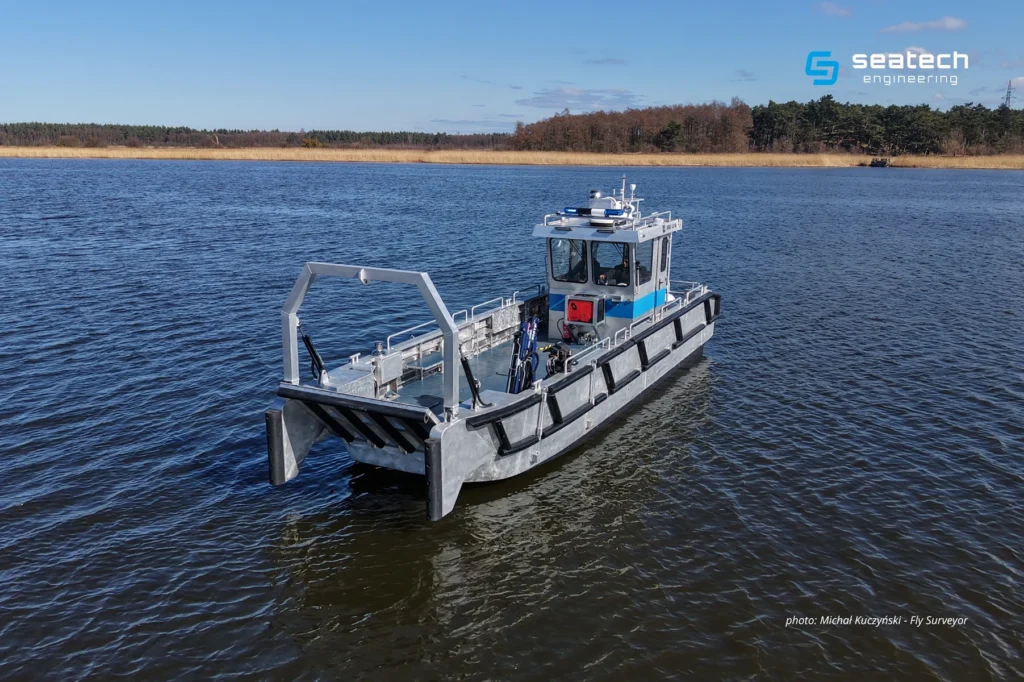
SE-230 Landing Craft, designed by Seatach Engineering, built by JABO Shipyard, photo by: Michał Kuczyński / Fly Surveyor
Landing Craft – a multi-purpose unit designed for operations on coastal and inland waters
SE-230 Landing Craft, designed by Seatach Engineering, built by JABO Shipyard, photo by: Michał Kuczyński / Fly Surveyor
Growing importance of inland transport, and the need associated to operate on shallow waters with limited access to port infrastructure, requires vessels designed to approach natural coastlines, combining durability, functionality and operational independence. The answer to such challenges are Landing Crafts – proven designs enabling operations within areas impossible to reach by other vessels.
Design characteristics
Landing crafts are specialized vessels designed to transport cargo, vehicles and personnel to other ships or directly to shore. A key feature of these units is their hull design with a bow loading ramp. It enables rapid loading and unloading, via a roll-on/roll-off system, onto shores without dedicated infrastructure such as beaches, grassy and rocky shores or other hard to reach landing sites. Thanks to dedicated ramp, vessels of this type do not require the use of lifting equipment, though they may, of course, be equipped with specialized inventory if required by planned operations. Such design ensures that logistics carried out by landing crafts are significantly shorter and do not require intermediate transshipment operations, which result in cost reduction and increased operational efficiency. Furthermore, operations conducted using these vessels eliminate the need for extensive port infrastructure and can take place in locations where access to the waterfront is limited or completely impossible.
Another landing crafts’ key characteristic is their displacement and payload (deadweight), and therefore their draught, crucial during operations on coastal and inland waters. These features are influenced by the construction material, which is determined by displacement versus payload analysis, taking into account also the nature of vessel’s operations and the type of carried cargo. It can be aluminum, steel or GRP (Glass Reinforced Plastic). Thus, while maintaining the same main hull dimensions and intended payload, the use of steel results in greater draught or desired draught at the expense of the deadweight. On the other hand, using GRP for the hull structure results in shallower draught than intended for the same deadweight, or, likewise, maintaining design draught with increased payload. It is worth mentioning, however, that the physical properties of GRP are not always able to ensure suitable conditions for carried out operations, particularly regarding deck durability. In landing crafts of relatively short length an aluminum hull proves to be a good choice as it offers a convenient displacement to payload ratio and allows shallow draught, and, as a result, operating on shallow waters, at temporary piers and even directly on the shore. This makes these vessels an extremely versatile work tool, suitable for a wide range of operations on inland waters.
A wide range of applications
The initial purpose of landing crafts was closely tied to military operations, particularly landing of troops during combat actions on unprepared coastlines. They gained the greatest importance during World War II, when it became necessary to conduct large scale landing operations in areas lacking port infrastructure. The reason for their use was practical – traditional ships were unable to approach the shore closely due to excessive draught and structural limitations caused by the lack of a ramp. As a result, it was necessary to transfer soldiers and equipment to smaller vessels or drop them off far from the shore, which significantly increased the loss risk and complicated logistics.
Today, landing crafts are used in much broader and versatile range of applications, offering benefits across various industries. The same vessel can be designed for transporting construction equipment, as well as rescue operations, industrial operations and tourism. In practice, landing crafts are used wherever standard solutions fall short. In hydrotechnical construction sector and activities related to building and maintaining port or transport infrastructure, such as bridges, the use of these vessels allows efficient delivery of equipment directly to the waterfront. Thanks to their adequate payload and a dedicated ramp designed for heavy loads, it is possible to transport heavy equipment to locations without road access and with no need to use land-based cranes. For these reasons, landing crafts are increasing their role in logistics in areas with lack of transportation infrastructure. The ability to load and unload independently allows these vessels to act as self-sufficient platforms, which directly results in greater operational flexibility. The outcome is clear – projects can be completed in shorter timeframe, without the need for temporary solutions and in locations previously considered difficult or unprofitable. A similar trend can be observed in the energy sector, where landing crafts can be used as support ships during the construction of offshore wind farms, as well as offshore and nearshore installations’ maintainance. The ability to transport various types of components directly to their destination, particularly to other vessels or directly to shore, shortens project timelines and reduces logistical risks.
Landing crafts are equally important in public services and emergency operations. Their design allows to operate in crisis conditions, in floodplains. As a result, these vessels become an effective tool in situations requiring rapid response, such as floods or evacuations, where the access to infrastructure is limited or destroyed. The ability to transport people, equipment and supplies within a single operation cycle means that rescue operations can be conducted more efficiently and safely. Furthermore, landing crafts are highly productive in firefighting operations in areas with limited land access, enabling the transport of firefighters, equipment and supplies directly to the scene of the incident. Thanks to their shallow draught, they can approach close to the shore, allowing rapid deployment of rescue forces and efficient evacuation of victims. These units can also serve as mobile firefighting platforms equipped with pumps and water cannons, as well as provide logistical support during prolonged rescue operations.
Landing crafts are also a useful tool for waterborne inspections and operations requiring the participation of divers. They enable transport of teams along with specialized equipment and provide a convenient platform for preparing and conducting dives. Thanks to a dedicated bow ramp, which can be additionally equipped with a flap or a ladder, divers can safely enter and exit the water. The vessel can serve as a technical support base, a decontamination area or a coordination point for underwater operations, particularly during infrastructure inspections, search operations or maintainance work.
Units like landing crafts can also be used for tourism and fishing purposes. Thanks to their high load capacity, good seakeepping performance and ability to land directly on unprepared shores, they allow for comfortable transport of groups of tourists or anglers, along with their equipment, straight to hard to reach locations such as wild coastlines, islands or shallow waters. Spacious deck is perfect for recreational trips, providing place to rest or observe the nature, and thanks to a ramp, loading and unloading of passengers and equipment is quick and safe.

SE-230 Landing Craft, designed by Seatach Engineering, built by JABO Shipyard, photo by: Michał Kuczyński / Fly Surveyor
Landing craft proven design
Our ship design office, which specializes in small and medium-sized vessels up to 100 meters long, has recently completed a project of a landing craft unit, which was built, outfitted and delivered to its owner in March, 2026. The vessel is the result of the cooperation between Seatech Engineering and JABO shipyard from Gdańsk, marking another joint project together.
The vessel under design number SE-230 (shipyard number LC10) is a technical motorboat, landing craft type, designed to support the infrastructure responsible for supplying drinking water from Vistula River to the capital city of Warsaw, including transport of cargo during operations, transport of the crew and cargo pipes along with dedicated ship equipment. The vessel was built on behalf of the Municipal Water Supply and Sewerage Company (MPWiK) in Warsaw, under classification supervision by Polish Register of Shipping (PRS).
Landing craft proven design
SE-230 Landing Craft, designed by Seatach Engineering, built by JABO Shipyard, photo by: Michał Kuczyński / Fly Surveyor
Our ship design office, which specializes in small and medium-sized vessels up to 100 meters long, has recently completed a project of a landing craft unit, which was built, outfitted and delivered to its owner in March, 2026. The vessel is the result of the cooperation between Seatech Engineering and JABO shipyard from Gdańsk, marking another joint project together.
The vessel under design number SE-230 (shipyard number LC10) is a technical motorboat, landing craft type, designed to support the infrastructure responsible for supplying drinking water from Vistula River to the capital city of Warsaw, including transport of cargo during operations, transport of the crew and cargo pipes along with dedicated ship equipment. The vessel was built on behalf of the Municipal Water Supply and Sewerage Company (MPWiK) in Warsaw, under classification supervision by Polish Register of Shipping (PRS).
Completed workboat is a high-speed vessel with a V-shaped aluminum hull. The length of the hull is 10 meters, and togehter with engines mounted at the stern, the overall length is just over 11 meters. Vessel’s draught at maximum load (2 tons) is approx. 0.6 m, ensuring wide range of operations on coastal and inland waters. Powered by two 120 kW diesel engines with propellers, the ship reaches the speed of 25 knots. In accordance with MPWiK’s operational needs, aforementioned landing craft, in addition to its dedicated bow ramp with a lifting capacity of 1300 kg, is additionally equipped with a 700 kg A-frame and a hydraulic crane with a lifting capacity of 250 kg at a 5-meter reach. The vessel provides 8 hours of continuous operation and can accommodate a crew of up to 4 people on board.
SE-230 as a base unit
Landing craft vessel for MPWiK is an example of a ship demonstrating only some of the capabilities of this type of units and serves as a foundation for further adaptations tailored to diverse needs and industries, not only on the Polish market. The range of applications mentioned above is broad – ranging from hydrotechnical engineering and quay construction, through support for seaports and inland ports, conducting firefighting and rescue operations, up to supporting the transport sectors in areas lacking coastal infrastructure, particularly on the Scandinavian market, where land transport is much more time-consuming than via inland waters.
The design characteristics of landing crafts, such as SE-230, are also significant. A lightweight aluminum hull with a shallow draught enabling the access to hard to reach areas, a bow ramp with high load capacity allowing Ro-Ro loading, as well as a large cargo capacity, relative to vessel’s size, ensuring transport of various types of inventory. In addition, dedicated equipment that can be arranged for specific operational purposes, and a heated cabin providing comfortable working conditions for the crew even in harsh weather conditions.
Completed SE-230 unit isn’t therefore a single project designed to meet specific needs of a single client, but rather a proven operational and technological model. It is a ready-to-use, verified product that has gone through the full cycle – from design, through construction to commissioning. This starting point significantly reduces the risk for future investors and shortens the lead time for subsequent units.
Video showcasing SE-230 Landing Craft unit, designed by Seatach Engineering, built by JABO Shipyard, film by: Michał Kuczyński / Fly Surveyor
The collaboration between Seatech Engineering and JABO, on yet another project, demonstrated full scope of supervision over vessel’s development proces – from design to construction – including aligning client’s requirements with ship’s capabilities and budget, as well as selecting appropriate materials and specialized equipment. SE-230 thus serves as a base platform – a structure that can be developed and modified depending on the specifics of planned operations, the type of cargo being transported, as well as environmental conditions. In practice, this means the ability to create specialized landing craft for entities across various sectors without the need to start the design process from scratch. Instead, the client receives a solution based on an existing, proven design that can be precisely tailored to their operational needs.
The conclusions are clear – in addition to versatile support functions, landing crafts are becoming specialized operational tools, designed for specific tasks and defined challenges. Completed SE-230 Landing Craft project demonstrates that a vessel of this type delivers wide range of benefits – from reducing the time required to complete tasks or projects in which it participates, through supporting the logistics process, to increasing operational independence. For potential investors, this means an access to a solution that serves as a proven foundation ready for further development. Collaboration with Seatech Engineering and JABO shipyard offers an opportunity to build a tailor-made vessel while leveraging an existing, tested design, which significantly reduces technical and investment risks. A comprehensive approach, covering design, construction and support during the implementation phase, ensures the consistency of the entire process and real time savings. As a result, landing craft units are no longer just means of transport but tools for building an operational advantage. For companies, operating within demanding water environments, this is an opportunity to increase efficiency, enter new areas of development and carry out projects that were previously out of reach.