Ship design – challenges in contracting process (part I)
Ship design is a complex process, requiring meticulous planning, risk management and the ability to make compromises between the buyer/owner, the design office and the shipyard/builder. Design services contracting process is based mostly on tendering procedures, but the practices vary both in terms of the nature of the owner (public or commercial) and the location (domestic projects or foreign tenders). The following article treats the differences in contracting ship design, affecting further stages of the project, based on our 20 years of experience in providing services for ship owners in different parts of the globe.
Briefly about design phases
To understand the challenges arising during contracting procedures, we must be aware that the ship design process consists of 4 main, closely related phases – concept design (also called initial), contract design, basic/class design and detail design (or workshop documentation). First three stages form a technical design phase of the vessel, while detail design represents phase two – production. Such division applies to most projects within the commercial market.
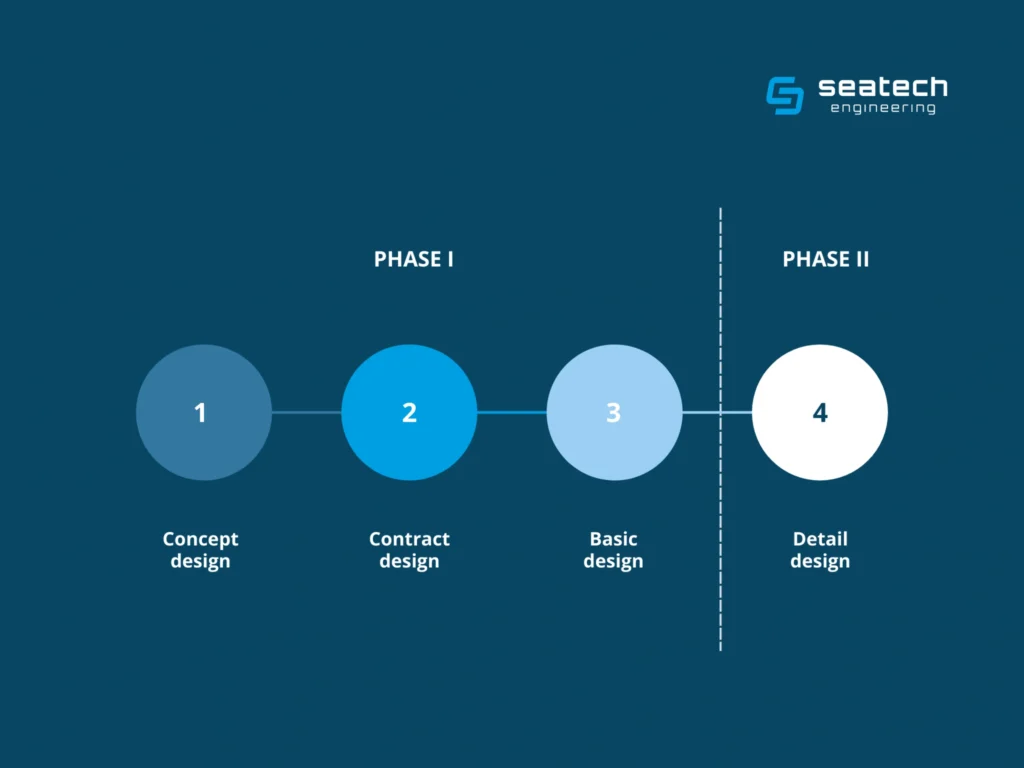
Division of the design process
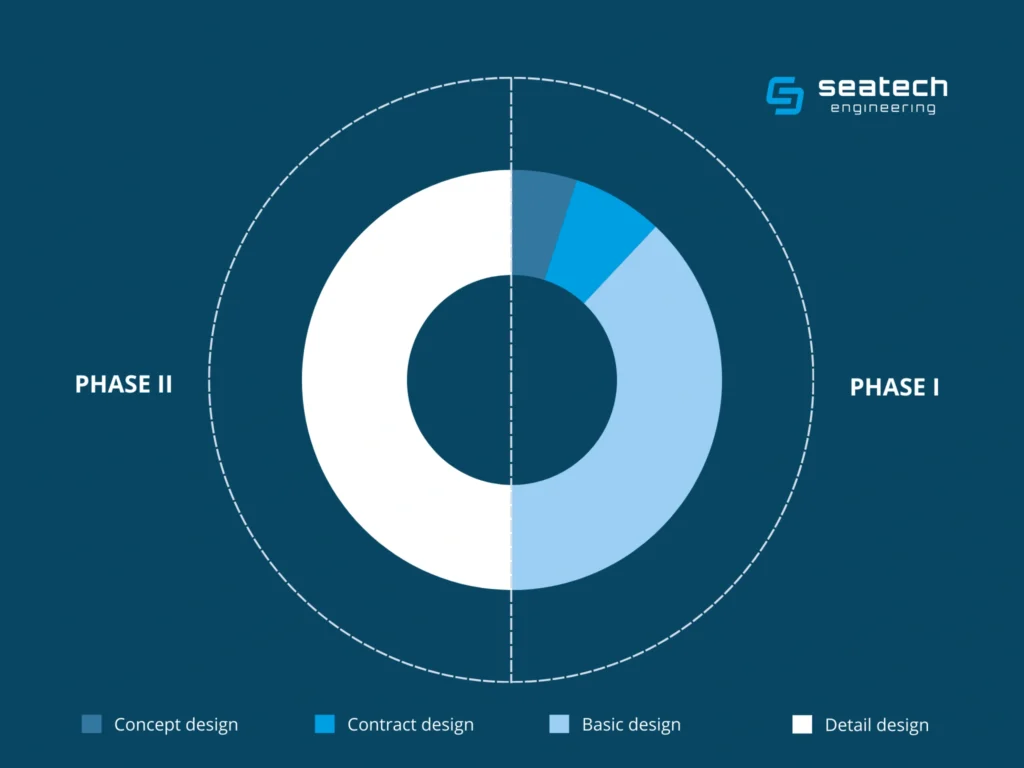
Ship design process division into stages in relation to the volume of work
Concept design consists of documentation including main assumptions of vessel’s parameters based on ship owner’s expectations. However, in order for the shipyard to price and sign a contract for the delivery of a ship, it is necessary to execute a contract design, taking into account the verification of concept assumptions. Only the contract scope, which includes, among others, general arrangement and technical specification of the vessel, construction weights and the list of main mechanisms and equipment, represents a set of verified input design data, necessary to make a reliable quotation and determine a real time of execution, i.e. delivery of ready unit. Further, class design is based on contract documentation. It is a set of necessary files including compliance with ship’s class notification and local administrative regulations, in accordance with the ship flag defined by the owner. Ready documents is submitted to the Classification Society for approval. Approved basic design is the foundation of the final stage of design work i.e. workshop documentation, which results in specific guidelines for the shipyard to build the vessel. The production phase, with regard to small and medium-sized vessels on which we mainly work on, is the most time-consuming design phase and is always within the scope of the shipyard selected for the construction.
Concept design consists of documentation including main assumptions of vessel’s parameters based on ship owner’s expectations. However, in order for the shipyard to price and sign a contract for the delivery of a ship, it is necessary to execute a contract design, taking into account the verification of concept assumptions. Only the contract scope, which includes, among others, general arrangement and technical specification of the vessel, construction weights and the list of main mechanisms and equipment, represents a set of verified input design data, necessary to make a reliable quotation and determine a real time of execution, i.e. delivery of ready unit. Further, class design is based on contract documentation. It is a set of necessary files including compliance with ship’s class notification and local administrative regulations, in accordance with the ship flag defined by the owner. Ready documents is submitted to the Classification Society for approval. Approved basic design is the foundation of the final stage of design work i.e. workshop documentation, which results in specific guidelines for the shipyard to build the vessel. The production phase, with regard to small and medium-sized vessels on which we mainly work on, is the most time-consuming design phase and is always within the scope of the shipyard selected for the construction.
Ship design process division into stages in relation to the volume of work
Different markets, different practices
Given the complexity of the ship design process and the strive to reduce risk at subsequent stages of execution, the process of contracting should be well thought out and involve relevant parties of buyer – design office – shipyard triangle at the appropriate design stage. Our experience shows that different markets have different practices in this matter.
In projects carried out by our office so far in France for example, the basis of the tender process or bidding process was a prepared concept design, representing the description of the unit, without drawing documentation. Bids in tenders were submitted by shipyards, which enclosed their proposal of general arrangement and technical specification of the vessel as a part of the tender documentation. As a result, later shipyard’s contract with the buyer included class and detail design, carried out by the shipyard itself – either with its own resources or under a separate contract with a selected design office. The situation differed, for example, in projects in Norway. Here, previously developed basic design, provided by the ship owner, was an input for the tender however, the shipyard participating in the tender had to take responsibility for delivered technical design, possibly verify it and make necessary adjustments before proceeding with ship’s workshop documentation, which was the subject of the contract.
In Poland, on the other hand, where the construction of new ships is contracted based mainly on tenders, the situation is quite different. In public ones, a common approach is to combine both design phases into a single tender. This means implementing the ‘design and build’ formula, an idea in which the design and construction of a ship is carried out by one entity, from the initial phase of the entire design process.
The situation is different on the commercial market. In the vast majority of cases, the stages of contract and basic design are separated. Only after obtaining a construction cost estimate, based on conducted earlier contract design, the decision to undertake or cancel the investment is made. If the implementation of the vessel is confirmed, the shipyard is selected and it signs a contract with the design office for class and detail design on its own.
Consequences of different approaches
Diversified practices in the area of contracting ship design work, in particular skipping the division into aforementioned two phases, indicates a number of consequences at subsequent stages of implementation. Developing preliminary assumptions without the participation of the design office results in contracting based on overall or incorrectly defined ship parameters or inappropriately selected equipment, while expecting the unit to fulfill certain functions at the same time. The result is mutually exclusive constraints – financial, technological and those generated by physics. Incorrectly selected and untested data already at the input stage generates the risk of not being able to meet project’s physical, budget and time assumptions. Errors resulting from misaligned guidelines effects in higher unforeseen design costs and greater overall construction price. The need to modify the basic assumptions of the vessel and, in extreme cases, also the dimensions of the main vessel, generates major problems in regards to public procurement law and tender specification. In addition, the implementation of the ‘design and build’ formula from the initial phase of the project unnecessarily shifts all the risk on the shipyard or design office, including those related to misdefined specification of tender subject.
From our office point of view, based on participation in a number of proceedings on different markets, the most effective solution for all parties is to divide the design work into two separate contracts – first including initial and contract design of the unit, and second – basic design and workshop documentation. The first tender then remains in the area of arrangements between the owner and the design office, while the shipyard joins the process when the second tender is announced and further implements class and detail design based on verified assumptions of the unit, i.e. finished contract documentation. Why such a solution is beneficial to all parties and affects executing the project on time and within the budget – let’s find out in part II of the article coming up soon.