The use of FEM analyses as a support tool for optimizing ship design process, and thus the construction and ultimate operation
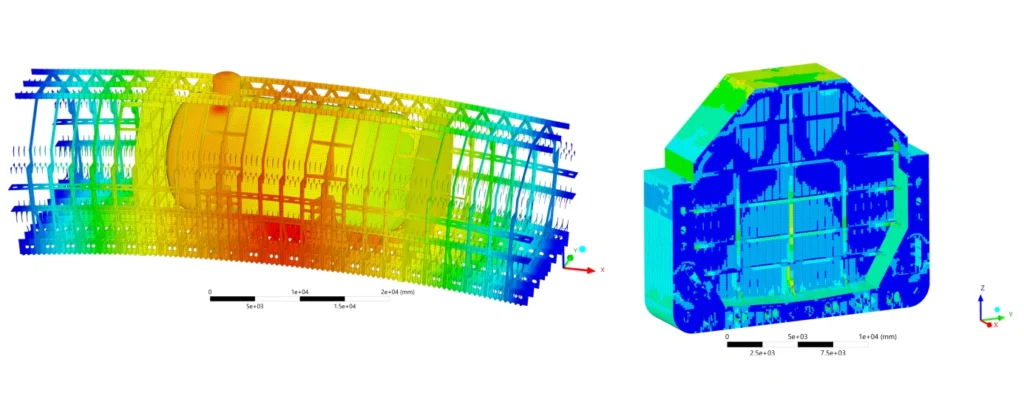
FEM model in the concept design of an LNG carrier
The use of FEM analyses as a support tool for optimizing ship design process, and thus the construction and ultimate operation
FEM model in the concept design of an LNG carrier
The key feature of the ships built today is the safety of their construction. In addition to protecting human life, the capability of operating in difficult conditions at sea and protecting natural environment is crucial. Furthermore, minimizing the risk of accidents and the costs of potential repairs, and thus high compensation payments, is also one of the key objectives of the shipbuilding process. The whole project must also be cost-effective and comply with agreed implementation schedules. The answer to these challenges is to optimize ship design in terms of quantity and weight of construction materials used. To this end, design offices use dedicated, specialized software to increase both precision and efficiency of strength calculations, as well as to comply with customer requirements and classification regulations and ensure the safety of the structure, while taking into account also the final cost of building the vessel.
Forecasting as the key to success
An essential element of structural design process are analysis enabling the prediction of ship’s behavior under specified loads, simulating real conditions and challenges at sea. In terms of structural analyses, Beam Models (BIM) have been a well-known method for years, using simplified 1D bar elements to present the structure along its axis, enabling calculations and analysis of its overall performance on water. In practice, BIM models are used for design and overall static assessment. They enable quick calculations and a framework analysis of structure’s performance, however without the ability to map the details or local stress concentrations. In order to perform a precise strength analysis, it is necessary to apply more complex tools. In such cases, designers reach out to another calculation method – Finite Element Method (FEM) – which involves dividing the structure into many small elements that together represent the complex geometry and behavior of indicated objects, using 2D or 3D models.
Both methods complement each other, but it doesn’t mean that all design offices use both of them. The application of FEM in the design process requires several important aspects to be fulfilled. Dedicated, modern software is a must-have. To use this software effectively, experienced engineers are needed along with appropriate training and practical knowledge in fields of geometry modeling, verification and interpretation of the results obtained, while ensuring that analyses are carried out at an efficient pace, in line with the schedule of the entire project. Seatech Engineering Team, specializing in the design of small and medium-sized vessels, includes such specialists and uses FEM analysis to create complete ship models from the early stage of the design process.
Key Benefits
The use of FEM calculations in ship design brings significant benefits both at the design stage itself – streamlining the process and ensuring the accuracy of calculations – and in the shipbuilding process and subsequent operation of the vessel by the shipowner. Based on our design methodology, FEM analyses and vessel models carried out at the initial stage of the process form a base for the entire concept. Engineers work on these models during subsequent stages of the project, and thanks to them, they can make real-time changes within the design.
The use of FEM enables a detailed assessment of structure’s behavior already at the initial design stage. It allows the selection and optimization of the connections throughout the entire hull structure, simultaneous integration of deck and hull equipment foundations, and detection of potential stress concentrations. This reduces the risk of expensive changes at later stages of development, which directly affects cost minimization. In addition, developing and verifying models using FEM in the initial phase allows faster implementation of ship’s workshop documentation, which is crucial for further operations in the shipyard.
An important aspect in terms of using FEM is also weight control, to be precise the relationship between the designed weight and the final weight of the ship, so called lightship. This is particularly important in the design of small vessels. The representation of weight within FEM model allows the comparison of planned weight value with the one calculated based on detailed lists and simulations. By breaking it down into groups and calculating the uncertainty for each one of them, the margins of target values can be significantly minimized. As a result, the deviations between assumed and actual weight are reduced. This methodology allows for real optimization of the hull at an early stage, thus achieving a lighter structure and, consequently, lower construction costs and lower fuel consumption during operation.
It’s also worth mentioning that the use of calculation models enables real-time control of the design process. A dedicated engineer analyzes the results obtained against defined criteria in all areas of the design step by step at every stage. Ongoing verification and possible improvements streamline the process and ensure further smooth design approval.
The implementation of FEM into ship design process therefore offers a number of benefits. It guarantees a reliable design while minimizing subsequent risks. Its use in the above-mentioned areas results in refined and verified documentation provided to the shipyard, what minimizes production problems, reduces the number of reworks, and facilitates assembly, as well as affects shorter construction and more predictable budget. The shipowner benefits from a design with higher reliability and durability, optimized in terms of weight and material consumption, as well as better prepared for extreme operating loads. As a result, the vessel requires lower investment contribution and operating costs, and thus greater efficiency and safety. Ultimately, the market value and competitiveness of the ship are increased – alternatively by reducing margins and being price-attractive, or by maximizing profits by maintaining margins at lower costs.
Class regulations
Classification requirements for the use of FEM methods in ship design have evolved significantly in recent years. Until 2014, regulations in this area were limited to guidelines. Taking as an example the largest classification society, DNV, we see that the scope of regulations and standards describing the use of FEM analyses in the design process of marine structures published by classification societies has clearly increased in recent years. These analyses are an important part of the design process. In terms of global analyses, however, the regulations focus mainly on large ships or so-called novel designs. There are few design offices on the Polish market that build FEM calculation models for small and medium-sized vessels, possibly in the area of the foundations. Seatech Engineering design office recognizes above-mentioned benefits and, having the necessary resources, includes FEM calculations in its own design methodology at every stage. The fact that smaller ships are not obligated to apply FEM doesn’t mean that design offices cannot take advantage of it. The modeling tools and programs currently available are so effective that the creation of beam models is becoming less and less cost-effective and is more of a support than a base for the conclusions necessary in the design process.
FEM in actual use
Considering the requirements necessary to use FEM analyses in the design process and the benefits of their application, it is worth checking out how this works in practice. As our office uses FEM in wide spectrum, we have a number of examples of ship models developed and associated challenges as well as actual benefits.
Last year, we’ve completed a project, including classification design and the part of detailed design, of the 44-meter Freezing Trawler, in which, in accordance with customer’s requirements, the hull shell from the inner bottom level to the highest deck level was stiffened only with secondary structure stiffeners. The side structure did not include typical web frames/stringers, i.e., primary structure stiffeners. Despite defined assumptions, the vessel had to meet necessary strength and buckling requirements for the entire structure. The classification society, in this case Bureau Veritas, classified this project as a “case-by-case approval,” which means an individual classification process for a specific vessel. In order to approve the hull documentation, it was necessary to build a detailed calculation model reflecting the stress levels in the areas of interest, i.e., in the side stiffeners and in the connections between their ends. Due to the fact that the web frames (in this case, stiffeners), in accordance with the class guidelines, had to be modeled with at least 3 elements at their height, the use of calculations using a shell model was invaluable.
The aforementioned trawler design required a lot of work on our side. At the time of signing the contract with the customer, no one assumed “case-by-case approval” model, where the requirements were non-standard. Thanks to the efficient use of FEM analysis and modeling, the design documentation was completed on schedule, and at the end of 2025, the hull, partially equipped in Poland, was transported to the shipyard in Faroe Islands to finalize vessel’s outfitting. The ship is to be handed over to the shipowner this summer.
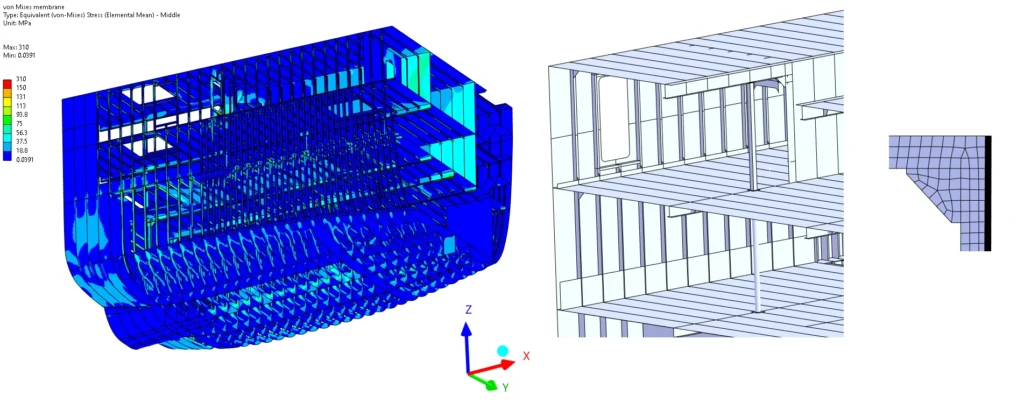
FEM model of a Freezing Trawler
FEM model of a Buoy Laying Vessel
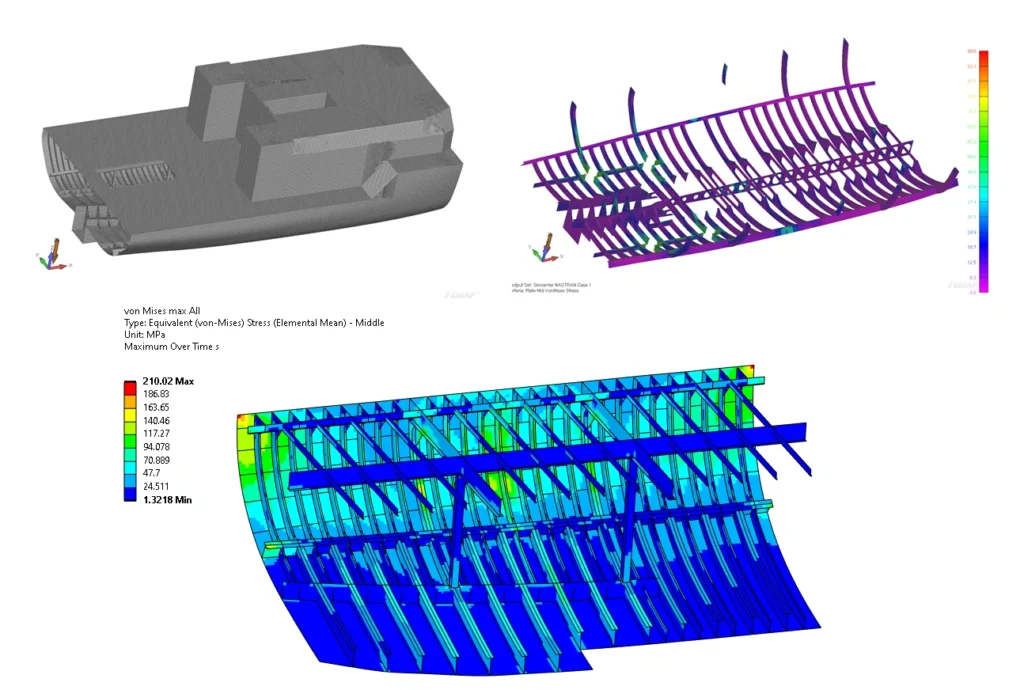
Another example of using FEM analysis in the design process is a comprehensive Buoy Laying Vessel project currently being carried out by Seatech Engineering. The ship, with a hull length slightly exceeding 24 m, i.e. the limit separating small and large ships according to the standards of Polish Register of Shipping, had to meet demanding requirements of ice class L1. Certain challenges arose already at the initial design stage. Applying minimum regulatory requirements for shell and frames thickness dedicated for large vessels, as well as the thickness of ice reinforcements defined by regulations, we had to deal with a hull that was too heavy for its expected shape right from the start. Here again, FEM modeling came to the rescue. Performed analysis of a detailed shell model, using the envelope of maximum regulatory loads as well as shell and girder thicknesses below minimum values, showed low stress levels within the hull structure. This enabled the classification society to consider exceptions from minimum requirements.
Another example of using FEM analysis in the design process is a comprehensive Buoy Laying Vessel project currently being carried out by Seatech Engineering. The ship, with a hull length slightly exceeding 24 m, i.e. the limit separating small and large ships according to the standards of Polish Register of Shipping, had to meet demanding requirements of ice class L1. Certain challenges arose already at the initial design stage. Applying minimum regulatory requirements for shell and frames thickness dedicated for large vessels, as well as the thickness of ice reinforcements defined by regulations, we had to deal with a hull that was too heavy for its expected shape right from the start. Here again, FEM modeling came to the rescue. Performed analysis of a detailed shell model, using the envelope of maximum regulatory loads as well as shell and girder thicknesses below minimum values, showed low stress levels within the hull structure. This enabled the classification society to consider exceptions from minimum requirements.
FEM model of a Buoy Laying Vessel
Furthermore, thanks to ice reinforcements analysis using FEM, it was possible to develop a significantly lighter hull structure in the ice belt area than defined by regulatory framework. This is one of the key aspects of the design process of small vessels, where weight control issues are common. In case of this Buoy Laying Vessel, preliminary estimated hull weight after FEM analysis ultimately coincided with the one obtained based on finished Cadmatic model.
Structural analysis and modeling using FEM are essential tools for optimizing modern ship design, construction, and operation in terms of constantly increasing safety requirements and delivery time pressures, while ensuring financial efficiency. Although beam models still play an important role in structural analysis, the use of Finite Element Method allows optimized ship design and effective weight control. The design methodology used by Seatech Engineering clearly shows that the implementation of FEM ensures ongoing verification of structural solutions, limiting the risk of costly changes, streamlining the design approval process and developing refined workshop documentation for the shipyard. We can receive a lighter, more reliable, and detailed design, which results in lower construction and operating costs and higher market value of the vessel, regardless of whether classification rules formally require the use of FEM analysis, as in case for small ships. In order to achieve expected results, both in terms of design and optimization of shipbuilding costs, the choice of the design office for the project is crucial. It is appropriate competences, resources and proficiency in using FEM that ensures the quality and reliability of design documentation submitted for production, which ultimately results in reduction of profitability risk of the entire investment.