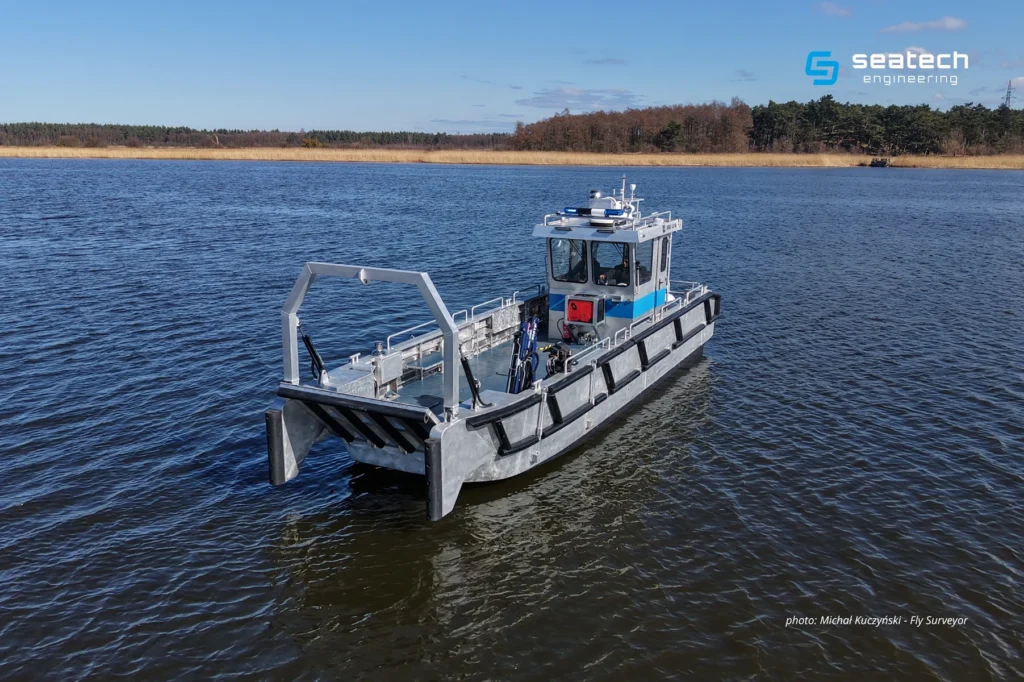
Landing Craft – a multi-purpose unit designed for operations on coastal and inland waters
Landing Craft – a multi-purpose unit designed for operations on coastal and inland waters Growing importance of inland transport, and the need associated to operate on shallow waters with limited access to port infrastructure, requires vessels designed to approach natural coastlines, combining durability, functionality and operational independence. The answer to such challenges are Landing Crafts – proven designs enabling operations within areas impossible to reach by other vessels. SE-230 Landing Craft, designed by Seatach Engineering, built by JABO Shipyard, photo by: Michał Kuczyński / Fly Surveyor Landing Craft – a multi-purpose unit designed for operations on coastal and inland waters SE-230 Landing Craft, designed by Seatach Engineering, built by JABO Shipyard, photo by: Michał Kuczyński / Fly Surveyor Growing importance of inland transport, and the need associated to operate on shallow waters with limited access to port infrastructure, requires vessels designed to approach natural coastlines, combining durability, functionality and operational independence. The answer to such challenges are Landing Crafts – proven designs enabling operations within areas impossible to reach by other vessels. Design characteristics Landing crafts are specialized vessels designed to transport cargo, vehicles and personnel to other ships or directly to shore. A key feature of these units is their hull design with a bow loading ramp. It enables rapid loading and unloading, via a roll-on/roll-off system, onto shores without dedicated infrastructure such as beaches, grassy and rocky shores or other hard to reach landing sites. Thanks to dedicated ramp, vessels of this type do not require the use of lifting equipment, though they may, of course, be equipped with specialized inventory if required by planned operations. Such design ensures that logistics carried out by landing crafts are significantly shorter and do not require intermediate transshipment operations, which result in cost reduction and increased operational efficiency. Furthermore, operations conducted using these vessels eliminate the need for extensive port infrastructure and can take place in locations where access to the waterfront is limited or completely impossible. Another landing crafts’ key characteristic is their displacement and payload (deadweight), and therefore their draught, crucial during operations on coastal and inland waters. These features are influenced by the construction material, which is determined by displacement versus payload analysis, taking into account also the nature of vessel’s operations and the type of carried cargo. It can be aluminum, steel or GRP (Glass Reinforced Plastic). Thus, while maintaining the same main hull dimensions and intended payload, the use of steel results in greater draught or desired draught at the expense of the deadweight. On the other hand, using GRP for the hull structure results in shallower draught than intended for the same deadweight, or, likewise, maintaining design draught with increased payload. It is worth mentioning, however, that the physical properties of GRP are not always able to ensure suitable conditions for carried out operations, particularly regarding deck durability. In landing crafts of relatively short length an aluminum hull proves to be a good choice as it offers a convenient displacement to payload ratio and allows shallow draught, and, as a result, operating on shallow waters, at temporary piers and even directly on the shore. This makes these vessels an extremely versatile work tool, suitable for a wide range of operations on inland waters. A wide range of applications The initial purpose of landing crafts was closely tied to military operations, particularly landing of troops during combat actions on unprepared coastlines. They gained the greatest importance during World War II, when it became necessary to conduct large scale landing operations in areas lacking port infrastructure. The reason for their use was practical – traditional ships were unable to approach the shore closely due to excessive draught and structural limitations caused by the lack of a ramp. As a result, it was necessary to transfer soldiers and equipment to smaller vessels or drop them off far from the shore, which significantly increased the loss risk and complicated logistics. Today, landing crafts are used in much broader and versatile range of applications, offering benefits across various industries. The same vessel can be designed for transporting construction equipment, as well as rescue operations, industrial operations and tourism. In practice, landing crafts are used wherever standard solutions fall short. In hydrotechnical construction sector and activities related to building and maintaining port or transport infrastructure, such as bridges, the use of these vessels allows efficient delivery of equipment directly to the waterfront. Thanks to their adequate payload and a dedicated ramp designed for heavy loads, it is possible to transport heavy equipment to locations without road access and with no need to use land-based cranes. For these reasons, landing crafts are increasing their role in logistics in areas with lack of transportation infrastructure. The ability to load and unload independently allows these vessels to act as self-sufficient platforms, which directly results in greater operational flexibility. The outcome is clear – projects can be completed in shorter timeframe, without the need for temporary solutions and in locations previously considered difficult or unprofitable. A similar trend can be observed in the energy sector, where landing crafts can be used as support ships during the construction of offshore wind farms, as well as offshore and nearshore installations’ maintainance. The ability to transport various types of components directly to their destination, particularly to other vessels or directly to shore, shortens project timelines and reduces logistical risks. Landing crafts are equally important in public services and emergency operations. Their design allows to operate in crisis conditions, in floodplains. As a result, these vessels become an effective tool in situations requiring rapid response, such as floods or evacuations, where the access to infrastructure is limited or destroyed. The ability to transport people, equipment and supplies within a single operation cycle means that rescue operations can be conducted more efficiently and safely. Furthermore, landing crafts are highly productive in firefighting operations in areas with limited land access, enabling the transport of firefighters, equipment and supplies directly to the scene of the incident. Thanks to their shallow draught,